Showing posts with label navy. Show all posts

Monday, February 27, 2012

The Biggest Submarine in the world


File:Марка России 2006г №1081-Тяжелый атомный подводный крейсер с баллистическими ракетами проекта 941.jpg
A 2006 Russian stamp in honor of the Typhoon


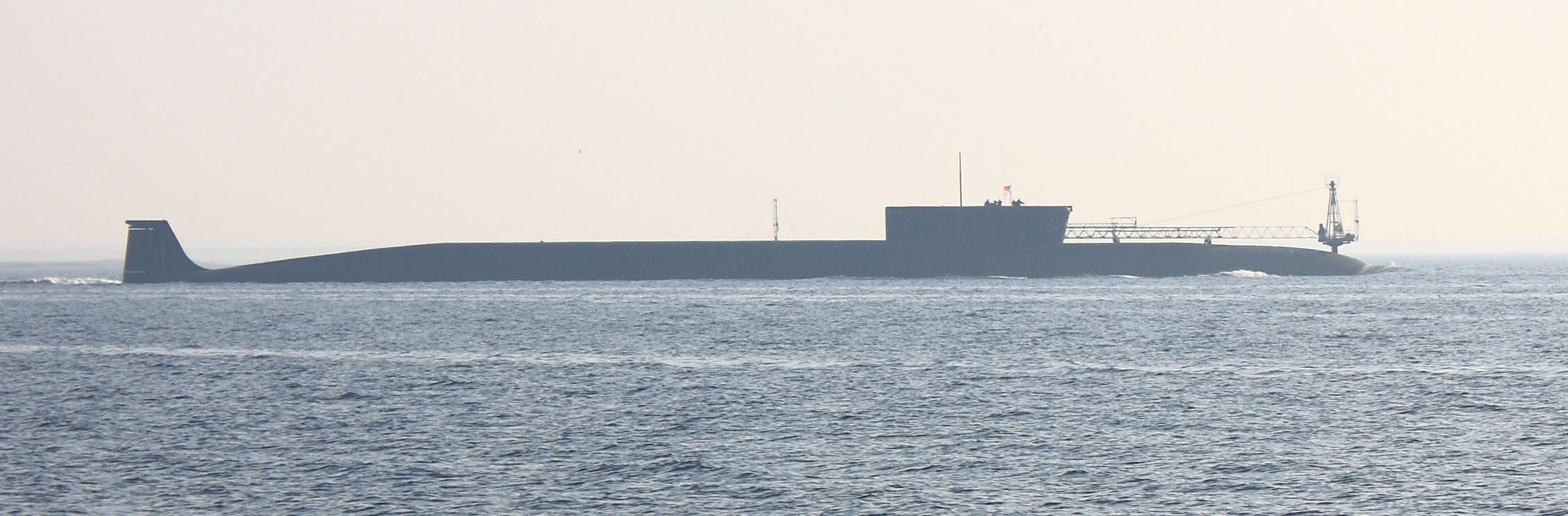
      The Typhoon class submarine is one of the most famous class of submarines in the world thanks to its size and movies like The Hunt for Red October. The Russians refer to the submarine as Project 941 Akula, which can be confusing considering that there is a fast attack submarine whose NATO classification is Akula.  The Submarine is 574 feet long and 75 feet wide, and when submerged displaces 48,000 tons.  Theoretically the submarine has the capability to remain at sea for 120 days or longer with a crew of 160.  
           The first Typhoon was commissioned with the Soviet Navy in the early 1980's. They were built in Severodvinsk in the White Sea. The Typhoons were built by placing two pressure hulls side-by-side, and then adding a third pressure hull that you can see protruding just below the sail. Because of this construction the Typhoon has a high degree of  survivability . If one pressure hull were flooded the crew could survive in the other pressure hull. 


941 Typhoon class image #1106
Typhoon in construction hall


They were intended to operate under the ice so as to avoid the NATO sonar nets that blocked the path to the Atlantic. For this purpose the sail was strengthened to allow for breaking through ice. 
941 Typhoon class image #112
Typhoon in drydock


      Many specialists classify the Typhoon as a second strike weapons platform, meaning that after an nuclear strike on the Soviet Union this submarine would be able to counterattack  in a retaliatory strike. Because these submarines were meant to stay at sea for extended periods of time they had some creature comforts that could not be found on any other Soviet submarines. These comforts included a small swimming pool, video games, and room where the crew could relax. 


World's Biggest Submarine - Russian Submarine Typhoon 87
Pool on the Typhoon


     To carry out this mission the Typoons carried 20 solid-fuel propellant R-39 (SS-N-20 NATO classification) missiles, with each capable of carrying 10 warheads.  They are arranged in two rows in front of the sail between the main hulls. In addition to the ballistic missiles the Typhoons carried torpedo and other weapons for self-defense. 
World's Biggest Submarine - Russian Submarine Typhoon 12
One of the missile tubes open.

     Six units were built and put into service with the Soviet Navy. Of those three units still exist, and three were scrapped under the Nunn-Lugar Cooperative Threat Reduction program. Here are the current status of the three remaining Typhoons:


-TK-208 Dmitriy Donskoy was converted to be the test bed for the new Bulava missile system. The Russian Navy has stated that this ship will remain as a test platform in the future.


-TK-17 Arkangelsk and TK-20 Severstal are both being held in reserve, and as recently as last week these submarines will be brought back into service in the near future. In order for that to happen these units would need to be refitted to carry the new Bulava missile or the Sineva missile, which is carried on the Delta-IV's. 


Like with so many things that are said by the Russian leadership, only time will tell if these submarines will ever put to sea again. 


DIA painting of Typhoon with a sub tender.


Friday, February 24, 2012


A New Navy


File:Vladimir Putin on board Peter the Great-1.jpg
Putin on board the warship Peter the Great

     This week soon to be president of the Russian Federation, Vladimir Putin, announced massive funding for the military. Over the next ten years he plans to spend 23 trillion rubles  ($775 billion US) on defense. While many are skeptical that this would actually happen, if it does it will be good news for a navy that is in dire need of new ships.
      In an article that appeared on the website of the Moscow Komsomolets Putin considers that the Russian Navy should receive 400 intercontinental ballistic missiles (ICBM), 8 ballistic missile submarines (SSBN), 20 multi-role submarines, more than 50 surface combatants, and nearly 100 military satellites. Here is the Russian from the article.

"400 межконтинентальных баллистических ракет наземного и морского базирования, 8 ракетных подводных крейсеров стратегического назначения, 20 многоцелевых подводных лодок, более 50 боевых надводных кораблей, около 100 космических аппаратов военного назначения"

     While the Russian Navy currently has more ships than those planned to be added, most of these ships are not capable of combat operations. Those ships that are added to the fleet will significantly increase the combat capabilities of the Russian Navy. Putin wants a blue water navy that is mainly concentrated in the North and Pacific fleets, and can protect Russia's interests in the Artic.

      According to RIA Novosti this is the current composition of the Russian Navy:


The Russian Navy
Russian Navy composition


Some other bullets of interest from the article:


File:K-535 Yuri Dolgorukiy at sea trials.jpg
Yuri Dolgoruki at sea

- According to Admiral Vysotsky (Commander of the Russian Navy), the Yuri Dolgoruki (Project 955) will join the fleet in 2012, and is expected to join the Pacific Fleet. The Alexander Nevski and Vladimir Monomak will join the fleet later, and construction of the fourth ship of the class will begin in March.

File:SSBN Typhoon.jpg
Model of Typhoon class submaine.

- The Typhoon class submarines (Project 941 Akula), Severstal and Arkangelsk,  will remain part of the fleet and will soon be carrying missiles. While the Dmitri Donskoy will remain a test platform for the Bulava.


Project 949 class submarine
Oscar class submarine underway

- The Belgorod, and Oscar class submarine (Project 949A) whose construction was halted some years ago, will be converted for special missions.

French Mistral

- The first Mistral will be named Vladivostok and will be based with the Pacific Fleet.

For the Russian speakers here is the article:


In other news from the Russian Navy:


Monday, February 20, 2012


Admiral of the Fleet of the Soviet Union Sergei Gorshkov

The man who made the Russian Navy what it is today is Sergei Gorshkov. 

Admiral Gorshkov on the cover of Time magazine in 1968

     Starting in 1956 until 1985 Admiral Gorshkov was commander-in-chief of the Soviet Navy. Under his leadership the Soviet Navy went from being a mainly coastal force into a force that was able to project power throughout the world.  Here is a quote from him expressing his accomplishment:


"The flag of the Soviet navy now proudly flies over the oceans of the world. Sooner or later, the U.S. will have to understand that it no longer has mastery of the seas."

—Admiral Sergei Gorshkov

     Gorshkov was born in present day Ukraine on Feb, 26, 1910. After finishing schooling there he first attended Leningrad State University (now Saint Petersburg State University), but he was then accepted into the Frunze military academy. When he graduated he first served on a minesweeper in the Black Sea Fleet, and then was transferred to the Pacific Fleet for several years. Just prior to the start of the Great Patriotic War (World War Two) Gorshkov returned to the Black Sea fleet and was the commander of squadron of cruisers. 

Hero of the Soviet Union

 During the war Gorshkov distinguished himself in battle, and finished the war with the rank of Vice Admiral. He then commanded the Black Sea Fleet from 1951-1955. For his actions during the war he was awarded the highest military decoration of the Soviet Union, Hero of the Soviet Union.
 In 1956 Gorshkov was appointed commander-in-chief of the Soviet Navy. Under his leadership the Soviet Navy started a massive build-up, and by the 1970's was a force that could challenge the Western naval forces. 

Gorshkov visiting a computer facility
Admiral Gorskov retired in 1985 finally having the fleet that he had dreamed of.  For his accomplishments he was awarded another Hero of the Soviet Union.

He passed away three years later and was buried in Novodevichy Cemetery. 

Headstone of Gorshkov

In his honor the Russian Navy renamed the aircraft carrier BakuAdmiral Gorshkov. 

Admiral Gorshkov 


And currently the Russian Navy is building a new class of frigates named in honor of Admiral Gorshkov. 


Read more: 

New York Times article published when Admiral Gorshkov died. 
http://www.nytimes.com/1988/05/15/obituaries/sergei-gorshkov-dies-at-78-admiral-built-soviet-navy.html